Sector Alarm’s Transparency Act statement
The purpose of the Transparency Act is to strengthen companies’ focus on and compliance with fundamental human rights and decent working conditions, as well as to provide consumers, journalists, and others with better access to information about what companies do to ensure compliance in this area. Similar initiatives have been launched in other countries where Sector Alarm operates, including France and the rest of the EU.
The Transparency Act imposes the following new obligations on Sector Alarm:
-
Duty to conduct a corporate review (due diligence) and risk assessment to evaluate the risk that the company or its suppliers and partners may violate fundamental human rights or requirements for decent working conditions
-
Duty to report annually on the findings of the risk assessment
-
Duty to respond to inquiries from third parties related to the Transparency Act within three weeks
Sector Alarm is one of Europe’s leading security providers, with more than 731,000 satisfied and safe customers. We have over 30 years of experience, delivering first-class alarm solutions to homeowners and businesses across Europe. Our customers are our top priority, and we’re proud to consistently achieve high satisfaction scores that reflect our commitment to excellent service.
Sector Alarm has experienced strong growth over the years and continues to expand in both new and existing markets. Today, we are over 4,200 employees operating in Norway, Sweden, Finland, Ireland, Spain, France, Italy, and Portugal. Our focus on hiring the right people has enabled us to offer customers state-of-the-art security solutions and achieve strong market positions in the countries in which we operate.
Below is an overview of Sector Alarm’s actions and assessments related to the Transparency Act.
This statement applies to Sector Alarm Topco AS, including its subsidiaries that are subject to reporting obligations under the Transparency Act. This includes Sector Alarm Holding AS, Sector Alarm AS, Sector Alarm Tech AS, SA Salg AS, Sector Alarm Drift AS, and Sector Alarm Midco AS.
Accountability
Sector Alarm has ethical guidelines that apply to all employees, hired personnel, project workers, and consultants throughout the Group. The company’s ethical guidelines can be found under code of conduct.
Sector Alarm has established board instructions that define the roles, areas of responsibility, and procedures for the Board and Group Management. These instructions are based on the principles of the Norwegian Corporate Governance Board (NUES) and the Norwegian Companies Act. In line with other key principles of good corporate governance, they emphasize that responsibility for Sector Alarm’s ESG efforts and for ensuring compliance with fundamental human rights and decent working conditions ultimately rests with the Board and Group Management across all companies within the Sector Alarm Group.
Supplier code of conduct
Sector Alarm has a supplier code of conduct based on guidelines from the Confederation of Norwegian Enterprise (NHO), Transparency International, and the UN Universal Declaration of Human Rights. The Code includes the following sections:
- General compliance with applicable legislation
- Corruption, fraud, and bribery
- Respect for human rights and requirements for decent working conditions
- Sanctions
- ESG
The purpose of the supplier code of conduct is to clarify Sector Alarm’s expectations of its suppliers and partners. The Board has instructed that the code must be fully, or at least principally, integrated into all new supplier agreements, as well as in the renewal of existing ones. Sector Alarm faces challenges in implementing this across all supplier contracts, particularly with large multinational suppliers that rely on standardized agreements with limited flexibility for customization.
Nevertheless, Sector Alarm has prioritized ensuring that all suppliers commit to respecting fundamental human rights and decent working conditions. Therefore, we sometimes accept alternative contractual commitments beyond strict adherence to our supplier code of conduct, for example by referring to the supplier’s own guidelines or applicable legislation. Sector Alarm strengthened supplier requirements in this area during 2024 and will continue to focus on this in 2026.
Improved procurement processes
As part of Sector Alarm’s work with ESG in general and the Transparency Act specifically, the company has taken several steps to improve procurement processes. Group Management has approved guidelines for supplier management and procurement that define processes, roles, and responsibilities related to procurement activities. These guidelines have also been consolidated into interactive instructions on how to be a better buyer, which have been distributed to all administrative leaders within Sector Alarm.
Additionally, in spring 2024, digital training sessions were carried out for employees involved in procurement.
Training and awareness
In August 2023, a training session was held for all administrative leaders within Sector Alarm in connection with the Transparency Act, focusing on what Sector Alarm must do to ensure compliance. The session was recorded and shared with anyone unable to attend.
Further training has been provided in various forums across the Group, such as CFO and General Manager meetings, board meetings, and other relevant gatherings.
This focus on training and awareness, particularly in relation to supplier management, will continue in 2026 under the responsibility of the Group Procurement Director.
Screening
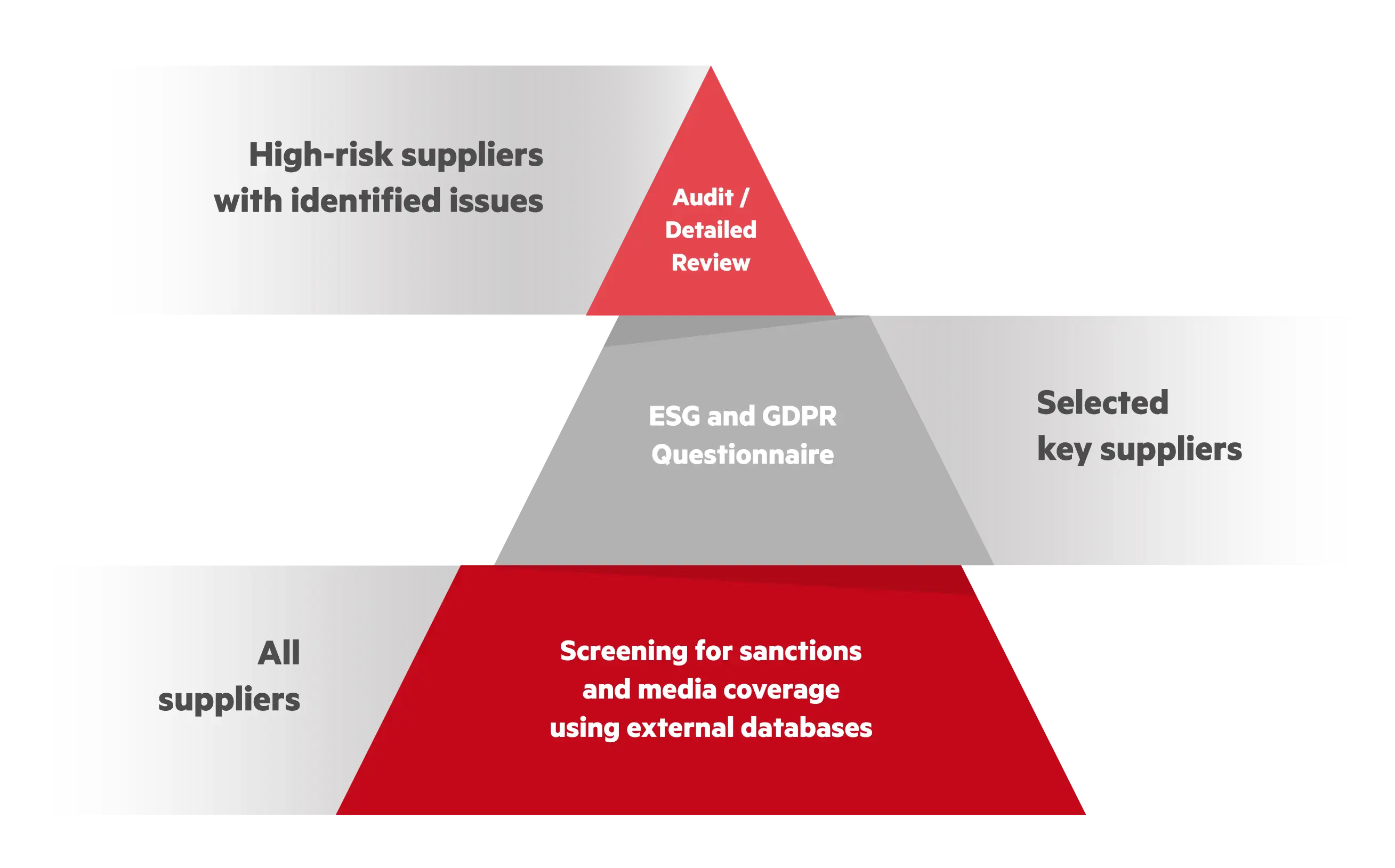
According to Sector Alarm’s guidelines, all new suppliers, partners, and service providers must be screened in an external risk and media database before any contracts are signed or payments made. The screening checks whether the third party appears on any international sanctions list or is connected to politically exposed persons or government entities. It also covers negative global media coverage, including public investigations, lawsuits, antitrust violations, human rights breaches, or labor-related disputes.
When negative media findings appear, we conduct a risk assessment of the supplier, evaluating factors such as the nature of the allegations, whether the violation is ongoing or historical, whether the incident is isolated or indicates a broader cultural issue, and the likelihood of future violations.
Sector Alarm has declined and terminated partnerships based on such screenings, especially when related to poor working conditions.
In 2022, Sector Alarm screened its existing supplier base in addition to new suppliers. A total of 2,315 suppliers were screened. Some required follow-up, where suppliers were contacted for additional information.
In addition to ongoing screening, the company re-screened approximately 600 key suppliers, representing the majority of procurement volume, in the first half of 2024.
ESG and GDPR supplier questionnaire
A new criterion was introduced in 2022 following the implementation of the Transparency Act.
It concerns the risk that a supplier or partner may violate fundamental human rights or fail to ensure decent working conditions. The selection process also considered screening outcomes, particularly when media searches revealed past allegations. Industry-specific factors were also taken into account, for example, the textile industry, which has historically been associated with child labor.
The supplier questionnaire includes several questions on human rights and decent working conditions, as well as on corruption and bribery. Responses are reviewed by the contract owner, who is responsible for any required follow-up actions.
Some suppliers, mainly large international technology companies, did not respond, as they generally lack the capacity to complete individual customer questionnaires. In such cases, references are typically made to publicly available reports on their websites or to independent third‑party audit reports.
Risk assessment
In 2022, administrative employees participated in a workshop to conduct a risk assessment related to the new Transparency Act. The assessment had two parts: Whether Sector Alarm itself violates any fundamental human rights or decent working conditions within its own operations, and whether any of Sector Alarm’s suppliers or partners might violate these rights or requirements.
For Sector Alarm’s internal operations, the highest‑identified risks concerned the working environment for employees, consultants, temporary staff, and contract workers, such as compliance with working hour regulations, prevention of bullying and harassment, and ensuring adequate safety routines to protect installation technicians working at customer sites. Because established measures are already in place, ethical guidelines, policies, whistleblowing channels, and safety procedures, these risks were not assessed to represent a high residual risk. Nevertheless, continuous improvements remain a priority in 2026.
Regarding suppliers and partners, Sector Alarm has not identified any significant or high risks of contributing to or being directly linked to human rights violations.
Key procurement categories include:
- IT services (software, hardware, licensing, consulting)
- Production of uniforms and workwear
- Production of alarm components and hardware
- Partnerships with security companies providing emergency response services
- Digital marketing services
Uniform and hardware suppliers are subject to strict contractual requirements regarding human rights, safe working conditions, waste management, carbon emissions, prohibition of illegal child labor, and fair working terms such as equal pay, written contracts, and overtime compensation. No high residual risks have been identified in these categories.
Emergency response services are considered very low risk due to strict regulatory requirements and oversight in the industry.
Digital marketing is an important part of Sector Alarm’s strategy, and campaigns run on Facebook, Snapchat, Google, Instagram, TikTok, and others. With regard to human rights, the identified risk primarily relates to the right to privacy. This assessment is based on decisions from European data protection authorities, news articles, and other public sources.
Sector Alarm has taken several measures to mitigate these risks, including updated privacy and cookie policies, updates to the cookie consent platform, data protection impact assessments, GDPR reviews of data processing activities related to digital marketing, and reviews of relevant supplier contracts.
Despite these measures, the risk cannot be eliminated entirely due to limited insight into international platform providers’ data processing practices.
Workshops will also be carried out in 2026 for deeper risk assessments.
Whistleblowing channel
Sector Alarm has a whistleblowing channel available on our website for the general public. Anyone can submit a report, anonymously if preferred. According to board‑approved procedures, human rights violations and concerns about poor working conditions may also be reported via this channel.
In 2024, we received 35 reports. None involved alleged human rights or labor condition violations. One report concerned an HR matter and was handled according to internal procedures.
The company also conducts an anonymous employee satisfaction survey, where respondents can provide feedback or raise concerns related to human rights or unreasonable working conditions.
Any such reports would be handled according to the company’s whistleblowing procedures to ensure fair and thorough follow‑up.
Information
Inquiries related to the Transparency Act may be directed to: compliance@sectoralarm.com.