Sector Alarm’s statement pursuant to the Norwegian Transparency Act
Background and purpose
The purpose of the Norwegian Transparency Act is to strengthen companies’ focus on and compliance with fundamental human rights and requirements for decent working conditions, and to give consumers, journalists and others improved access to information about what companies do to ensure compliance in this area. Similar initiatives have been launched in other European countries where Sector Alarm operates. The Transparency Act imposes the following obligations on Sector Alarm:
- An obligation to conduct due diligence and risk assessments to identify whether the company or its suppliers and business partners violate fundamental human rights or requirements for decent working conditions.
- An obligation to report annually on the results of the risk assessments.
- An obligation to respond to requests from third parties related to the Transparency Act within three weeks.
Description of the business
Sector Alarm is one of Europe’s leading security providers, with more than 730,000 satisfied and secure customers. We have over 30 years of experience in the Norwegian market and deliver high‑quality alarm solutions to homeowners and businesses throughout Europe. Delivering excellent customer service is extremely important to us, and we are proud of our consistently high customer satisfaction ratings.
Sector Alarm has experienced strong growth and continues to expand in both new and existing markets. The group employs more than 4,200 people operating in Norway, Sweden, Finland, Ireland, Spain, France, Italy and Portugal. Our focus on hiring the right people enables us to deliver state‑of‑the‑art security solutions and to maintain strong market positions.
This statement applies to the 2025 financial year and is prepared in accordance with Section 5 of the Norwegian Transparency Act. It applies to Sector Alarm Topco AS and its subsidiaries subject to the Act, including Sector Alarm Holding AS, Sector Alarm AS, Sector Alarm Tech AS, SA Salg AS, Sector Alarm Drift AS and Sector Alarm Midco AS (together referred to as “Sector Alarm”).
Sector Alarm has adopted a group‑wide approach to compliance with the Transparency Act. The group establishes common guidelines, due diligence frameworks and reporting processes and is responsible for preparing and publishing this annual statement. Operational implementation, including supplier follow‑up and risk‑mitigating measures and handling deviations, is carried out locally as part of ordinary business operations. Contract owners and local management apply the group framework with support and oversight from group functions.
The group collects and consolidates information from group companies and ensures that identified risks, findings and measures are reflected in the statement and escalated where appropriate. The statement has been reviewed and approved by the boards of all companies covered, and signed board minutes documenting approval are in place. This report is also available in Norwegian at www.sectoralarm.no/apenhetsloven.
Below is an overview of Sector Alarm’s measures and assessments in 2025 to meet the requirements set out in the Transparency Act.
Accountability
Sector Alarm has ethical guidelines applicable to all employees, hired personnel, project workers and consultants throughout the group. The guidelines are publicly available through the Code of Conduct.
Sector Alarm also has a board instruction describing roles, responsibilities and authority of the board and group management. The instruction follows the Norwegian Code of Practice for Corporate Governance (NUES) and the Norwegian Private Limited Liability Companies Act. In addition to other key principles of good corporate governance, the instruction emphasizes that the responsibility for Sector Alarm’s ESG efforts, and for compliance with fundamental human rights and requirements for decent working conditions across all entities in the Sector Alarm group, ultimately lies with the Board of Directors and the Group Executive Management.
Supplier ethics
Sector Alarm’s ethical guidelines for suppliers are based on principles from the Confederation of Norwegian Enterprise (NHO), Transparency International and the UN Universal Declaration of Human Rights. The guidelines address:
- Compliance with applicable law
- Corruption, fraud and bribery
- Human rights and decent working conditions
- Sanctions
- ESG considerations
The purpose of the Supplier Code of Conduct is to clarify Sector Alarm’s expectations of its suppliers and partners. The board has instructed that these guidelines be integrated into new supplier agreements and contract renewals. Where this is not feasible due to standard contractual frameworks, alternative commitments are accepted, such as compliance with the supplier’s own policies or applicable legislation. Supplier expectations in this area were strengthened in 2025 and will remain a priority.
Procurement and supply chain
Sector Alarm has procurement and supplier‑management guidelines defining processes, roles and responsibilities. During 2025, a newly appointed Group Procurement Director conducted a structured review of existing frameworks, policies, risk assessments and supplier questionnaires. This work supports consistent group‑wide compliance and responsible procurement practices.
Training and awareness
Sector Alarm provides digital training on the Transparency Act to administrative management. The training focuses on the actions Sector Alarm must take to ensure compliance with the law. Awareness initiatives are reinforced through management and board forums. Supplier compliance and responsible procurement remain a focus area by the Group Procurement Director.
Screening
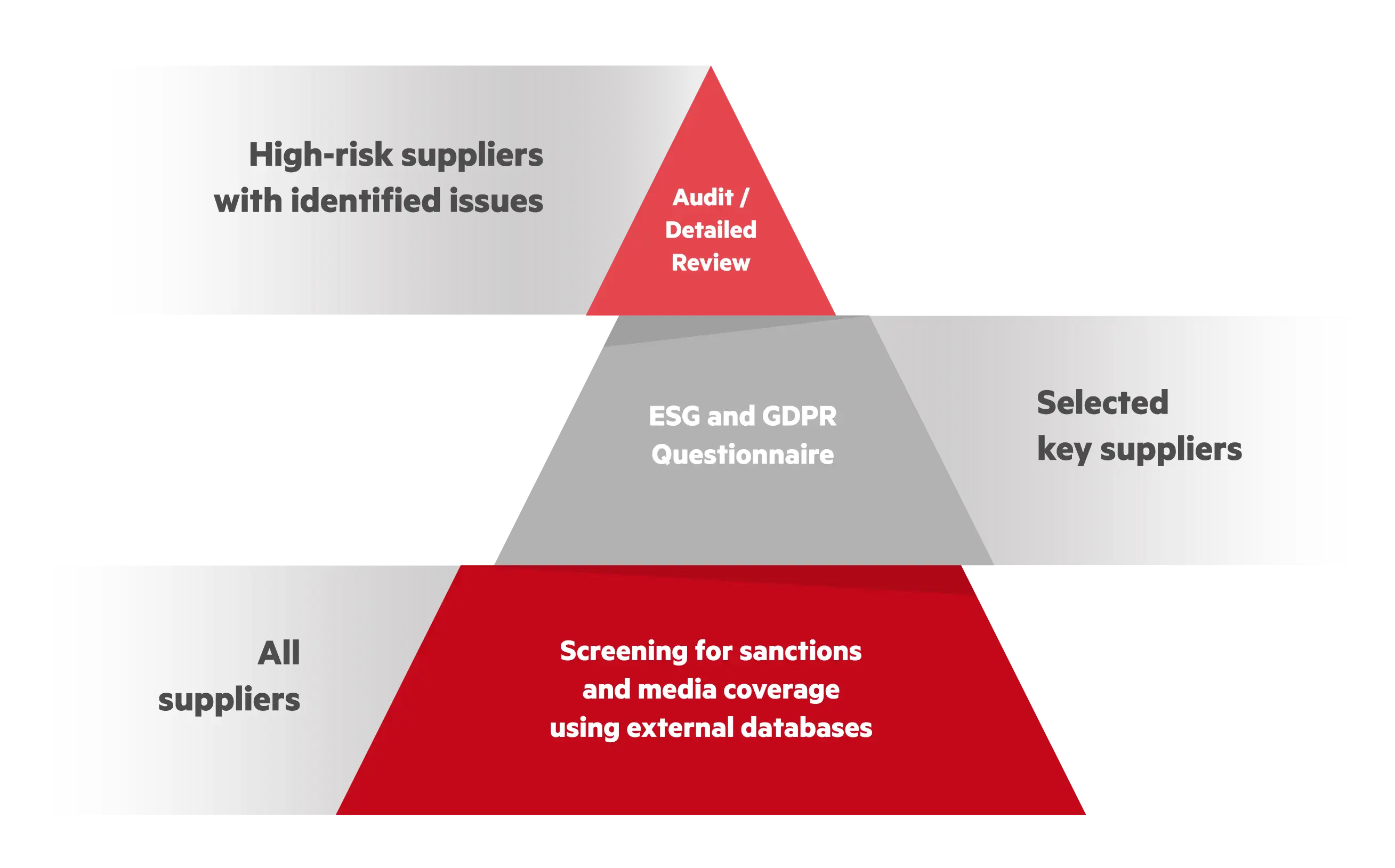
All new suppliers and partners are screened through an external sanctions and media database before contracts are signed or payments are made. Screening includes sanctions lists, politically exposed persons, and government affiliations. The screening will also include negative global media coverage relating to, for example, public investigations, litigation, breaches of competition law, human rights violations, or legal claims relating to inadequate working conditions.
If adverse findings are identified, we conduct a risk assessment of the relevant supplier. This assessment considers the content of the media coverage, whether the violation is ongoing or historical, whether it represents an isolated incident or indicates a broader culture of non-compliance within the third party, and the risk of future violations. As a result of findings from the screening process, Sector Alarm has rejected or terminated cooperation with third parties, particularly in cases involving poor working conditions.
In 2022, Sector Alarm screened its existing supplier base in addition to new suppliers. Sector Alarm has ongoing processes in place to explore various ways to streamline and improve the monitoring of both new and existing suppliers.
Supplier questionnaire
In 2025, Sector Alarm conducted a questionnaire covering human rights, decent working conditions and anti‑corruption for selected key suppliers and partners. Responses are reviewed, and any required follow‑up is handled by contract owners and local management with support from group functions. For completeness, it should be noted that some suppliers have not responded to the questionnaire. In such cases, reference is typically made to information published on the supplier’s website or to independent third‑party audit reports available upon request.
Risk assessment
Sector Alarm has conducted a risk assessment of our suppliers to ensure we have a sound understanding of which suppliers and industries which warrant increased attention and oversight.
With regard to Sector Alarm’s own compliance with human rights and the relevant ILO conventions on decent working conditions, the most significant identified risks related to the working environment for our employees, consultants, temporary staff and agency workers. These risks included, for example, working hours (ensuring that overtime does not exceed statutory limits), preventing bullying and harassment in the workplace, as well as the risk that our HSE procedures do not sufficiently protect our security advisors against accidents while installing alarm equipment at customers’ premises.
To mitigate risks related to the working environment, Sector Alarm has established and further developed procedures for safe driving during working hours for employees using the company’s car fleet. This measure is anchored in the company’s HSE efforts and contributes to safe and sound working conditions for employees.
As part of the risk assessments under the Transparency Act, Sector Alarm has also assessed risks related to the increased use of artificial intelligence, including implications for data protection and information security. To strengthen risk assessments and ongoing follow-up, the company has established a dedicated cyber organization, appointed a Head of Cyber, and strengthened its GDPR efforts through the appointment of a new legal privacy lead, continued cooperation with local DPOs, and further development of existing procedures, in particular in connection with the onboarding of new suppliers.
Given that the company has already established measures such as ethical guidelines, policies, whistleblowing channels and clear workplace safety instructions, none of the identified risks are considered to represent a high residual risk of human rights violations or inadequate working conditions. That said, Sector Alarm works continuously to further improve these areas in order to protect both customers and personnel from any such violations, and this work will continue in 2026.
On the supplier and partner side, Sector Alarm has not identified any material or high risks of contributing to, or being directly linked to, human rights violations through its partners and suppliers. With regard to spending categories, some of Sector Alarm’s largest supplier-related expenditures relate to IT services, including software, IT equipment and hardware, licenses, technical services and IT consultancy. This supplier category is not considered or assessed to carry a high risk of violations.
Excluding IT services, the following represent the most labor‑ and resource‑intensive categories in Sector Alarm’s supply chain:
- Production of uniforms and clothing for personnel
- Manufacturing of alarm components and hardware
- Partnerships with security companies for the provision of alarm response services
- Digital marketing services
Sector Alarm has clear contractual requirements requiring suppliers to respect human rights, in particular with respect to safe working conditions, waste management and carbon emissions, prohibition of illegal child labor, and requirements for decent working conditions (including equal pay, written contracts and overtime compensation). Based on our close cooperation with these suppliers, combined with ongoing dialogue and clear expectations, no high risks have been identified in relation to these supplier categories.
For alarm response services, the risk of non-compliance with applicable laws and regulations, including matters related to human rights and decent working conditions, is considered very limited, as this is a highly regulated industry subject to strict statutory requirements and effective regulatory oversight.
Digital marketing activities form an important part of Sector Alarm’s business strategy, both for promoting the company’s services and for advertising vacant positions. Sector Alarm runs digital marketing campaigns across all major digital platforms. From a human rights perspective, Sector Alarm has identified a risk related to the right to privacy in connection with such activities. This assessment is based on decisions and statements from EU data protection authorities, news articles and other publicly available sources. Sector Alarm has therefore implemented several measures to mitigate risks to the privacy of customers, job applicants and employees. Key measures include updates to the company’s privacy and cookie policies and its cookie consent platform, conducting data protection impact assessment, a broader GDPR assessment of certain processing activities involving personal data in the context of digital marketing, and a review of contracts with relevant service providers. Despite these measures, it is not possible for Sector Alarm to fully eliminate this risk, given the company’s limited insight into and control over the data processing practices of international platform providers.
Whistleblowing and employee surveys
Sector Alarm has a whistleblowing channel on our website that is available to the general public. Anyone may submit a whistleblowing report through this channel, and reports may be submitted anonymously if preferred. In accordance with the guidelines for handling whistleblowing cases, which have been approved by the Board of Directors, as well as the guidelines governing the whistleblowing channel, allegations relating to human rights violations and inadequate working conditions may also be reported through this channel. In 2025, Sector Alarm received 19 whistleblowing reports, none of which revealed violations of human rights or decent working conditions.
In addition to the whistleblowing channel, Sector Alarm conducts an anonymous employee survey on employee satisfaction for all employees. As part of this survey, employees may also provide feedback or raise concerns related to human rights or inadequate working conditions. In line with internal procedures, the next employee survey will be conducted in 2026.
As a supplement to the regular employee survey, a shorter anonymous employee survey was offered to all countries within the group in 2025. Several countries made use of this opportunity, including Norway, Sweden, Finland, Ireland and Spain.
Should allegations or suspicions of violations of human rights or requirements for decent working conditions be reported through the whistleblowing channel or the employee satisfaction survey, such reports will be handled in accordance with the company’s whistleblowing procedures. This includes an assessment of corrective and remedial measures where relevant, to ensure a fair and thorough follow‑up. Measures are determined on a case‑by‑case basis, taking into account the nature and severity of the matter, as well as the company’s actual ability to influence the situation.
Information
Requests related to the Transparency Act may be submitted to: